Visit

Visitor route

Four routes to discover the excavations, the necropolis, Lake Pellicone, and the natural landscape of the Park.

At the Vulci Naturalistic and Archaeological Park, visitors can admire the archaeological excavations of the ancient Etruscan and Roman metropolis of Vulci, the noble Etruscan tombs, and the artefacts displayed in the National Archaeological Museum, all immersed in an unspoilt natural setting that offers ever-changing colours, sounds, and emotions.

The canyon, formed by dark volcanic rock carved by the waters of the Fiora; the plateau populated by majestic Maremma cattle and free-roaming horses; the lush vegetation along the riverbanks, a refuge for wild boar, hares, porcupines and, in spring, skies coloured by the many rainbows of bee-eaters. Vulci is archaeology, nature and tradition!

It is also possible to visit the Northern Necropolis independently, every day during the Park’s opening hours. Following a route that is also accessible to people with reduced mobility, visitors can explore the Tomb of the Carved Ceilings and the Tomb of the Sphinx.

A few minutes by car from the Park ticket office, after crossing the Fiora, visitors will find the striking Badia Bridge and the National Archaeological Museum of the Castle of La Badia. The museum is state-run and closed on Mondays.

Inside the Park there is a refreshment point, “Casaletto Mengarelli”, and a restaurant near the ticket office, “Casale dell’Osteria”, where visitors can enjoy dishes from the Maremma tradition. The two restaurants are closed during certain periods in the winter months. We recommend contacting the facilities by phone for information or reservations.

Points of interest inside the Park

The Vulci Archaeological Park invites you on a fascinating journey into the heart of Etruscan and Roman civilisation. The route we suggest winds through the majestic remains of a city that was once a crossroads of cultures and an extraordinary power, allowing you to gradually discover its most significant treasures.

Mappa Archeologica

Types of routes

Short route

Short route

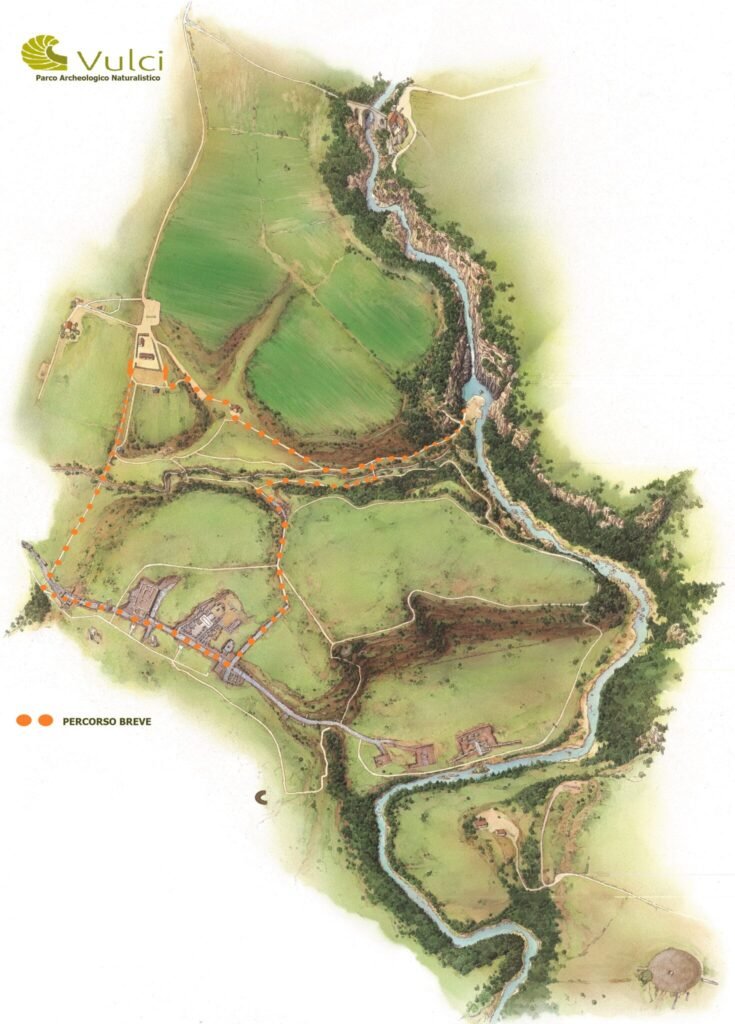
A 1 hour 30 minutes to 2 hours route with low difficulty

A 2-hour route with low difficulty
Self-guided route through the Park, covering the excavations of the Etruscan and Roman city.

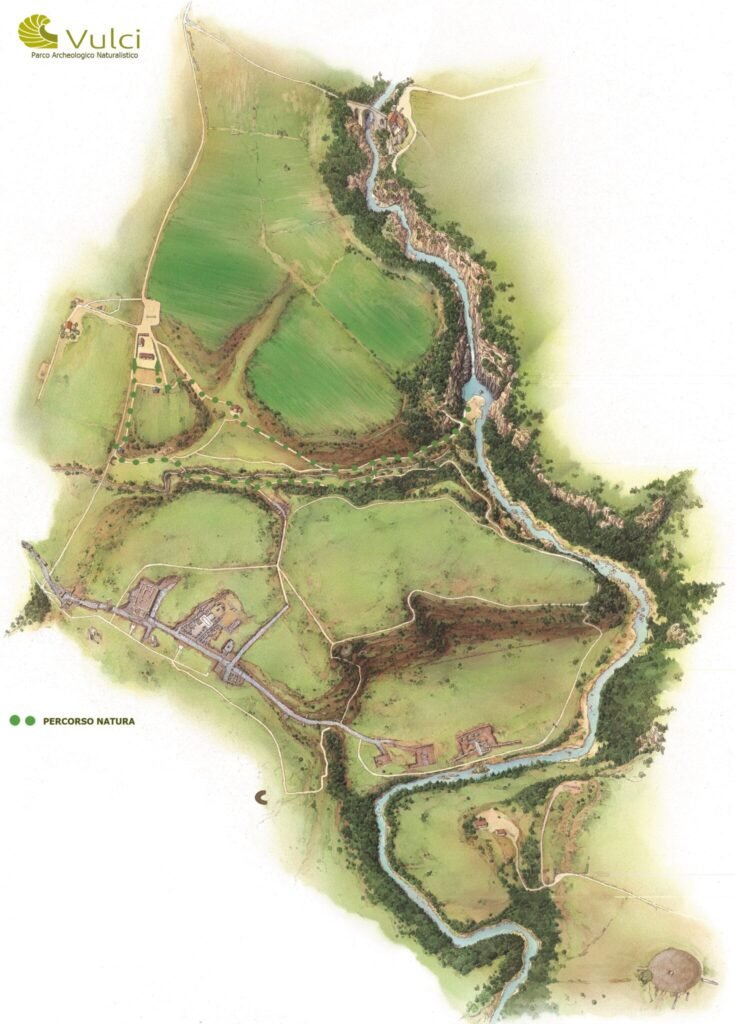
From the Park Meeting Point, at the Ticket Office, visitors follow a short path that climbs to the top of the plateau on which the ancient Etruscan and Roman city once stood. The route enters the Etruscan city through the West Gate and, walking along the Roman paved road, reaches the Great Temple and the nearby Brick Buildings and Apsidal Building. The visit continues with the evocative Domus of the Cryptoporticus, descending into the underground rooms of this Roman-period residence, and then reaches the Mithraeum. Following the northern stretch of the Cardo, visitors arrive at the North Gate. After crossing the Valley of Butterflies, the path continues into the denser vegetation until it reaches the shores of Lake Pellicone. From the lake, the route returns towards the Ticket Office, passing by the Refreshment Point.
Length 2.5 km
Duration 1 hour 30 minutes to 2 hours
Difficulty Low
Accessibility:
Accessible route for non-ambulant visitors on the top of the plateau; access to the underground rooms of the Domus of the Cryptoporticus is not possible.
Dog access People with disabilities Hiker Cycle route
Trekking shoes, a hat, and water are recommended.
Complete route

Complete route

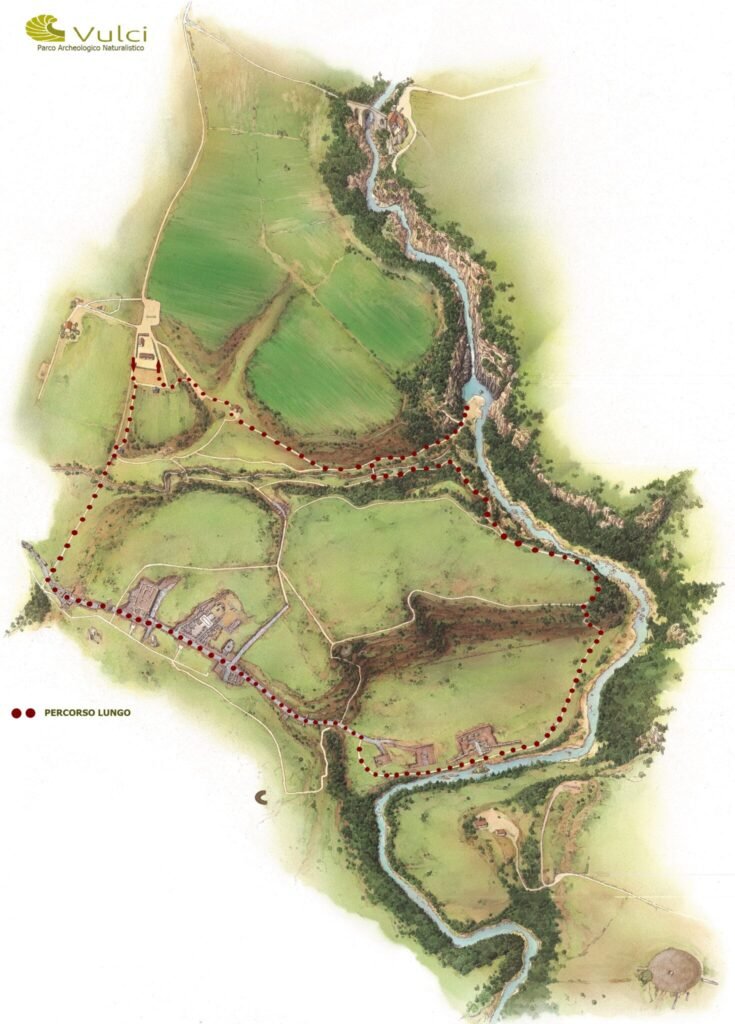
A about 3 hours route with medium difficulty

A route lasting 3 hours and suitable for everyone
Self-guided route through the excavations of the Etruscan and Roman city and to Lake Pellicone.

From the Park Meeting Point, at the Ticket Office, visitors follow a short path that climbs to the top of the plateau on which the ancient Etruscan and Roman city once stood. The route enters the Etruscan city through the West Gate and, walking along the Roman paved road, reaches the Great Temple and the nearby Brick Buildings and Apsidal Building. The visit continues with the evocative Domus of the Cryptoporticus, descending into the underground rooms of this Roman-period residence, and then reaches the Mithraeum. Returning to the decumanus, visitors cross the intersection with the cardo, pass the remains of the small sanctuary of Hercules and, after passing through the East Gate, leave the ancient city. Immediately outside the gate, the remains of the Basin used for sacred purposes can be seen. The decumanus then descends into the Fiora Valley, where recent excavations have brought to light the remains of the Emporium, the ashlar-block walls that also served as a river embankment, the bridge that crossed the Fiora, and several kilns used to fire black-gloss pottery. The path, bordered by fences, continues to the bottom of the valley, where the uphill section begins, together with the staircase leading back to the top of the plateau. Once at the top, the path follows the edge of the plateau on the right and then descends again, along several flights of steps, to Lake Pellicone. The return to the Ticket Office passes by the Refreshment Point.

Length 4.5 km
Duration about 3 hours
Difficulty Medium
Accessibility:
Only partially accessible to non-ambulant visitors.
Dog access Hiker
Trekking shoes, a hat, water, and food.
Nature route

Nature route

A 45 min route with low difficulty

A short route among the scents of nature.
Self-guided route to Lake Pellicone.

From the Meeting Point, at the Ticket Office, the path gently descends towards the valley at the foot of the ancient city. At the Giocaparco, the area where educational activities take place, the path turns left. Here, visitors can observe several aromatic plants that have been used since antiquity. The route then reaches the Tomb of the Spring. A few metres further on, to the right, a few steps lead to the small wooden bridge that crosses the City Ravine, on whose right bank there is a small group of tombs belonging to the earliest phase of life of the Etruscan city. Following the path along the right bank of the ravine, visitors reach, on the right, the remains of the North Gate and of the Decauville track used during the excavations of the 1950s. After crossing the Valley of Butterflies, the route enters the small woodland and, returning to the left bank of the ravine, reaches Lake Pellicone. The return route passes by the Refreshment Point.

Length 1.7 km
Duration 45 min
Difficulty Low
Accessibility:
Partially accessible to non-ambulant visitors.
Dog access Hiker Cycle route
Trekking shoes, a hat, and water.
Necropolis route

Necropolis route

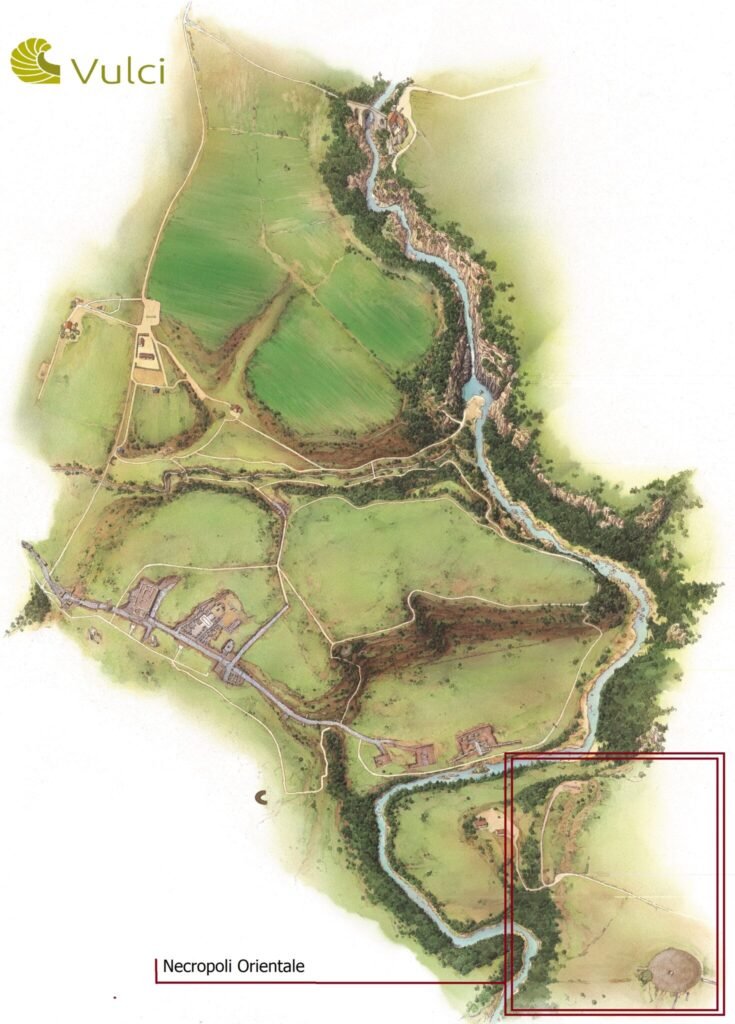
On the left bank of the Fiora River, opposite the plateau once occupied by the Etruscan city, lies the rich Eastern Necropolis. The area can be reached by car. The Eastern Necropolis includes some of the most important Etruscan tombs of Vulci. The Tomb of the Inscriptions and the famous François Tomb can be visited.

To visit the François Tomb and the Tomb of the Inscriptions, the educational guide service is required. Booking is mandatory, or visitors may take part in the guided tours scheduled during the spring and summer period.